Anker Lists in Hong Kong: How an "Accessory King" Is Fighting Its Way Into the AI Era — and What Cross-Border Brands Should Learn
Hi, I’m Riven.
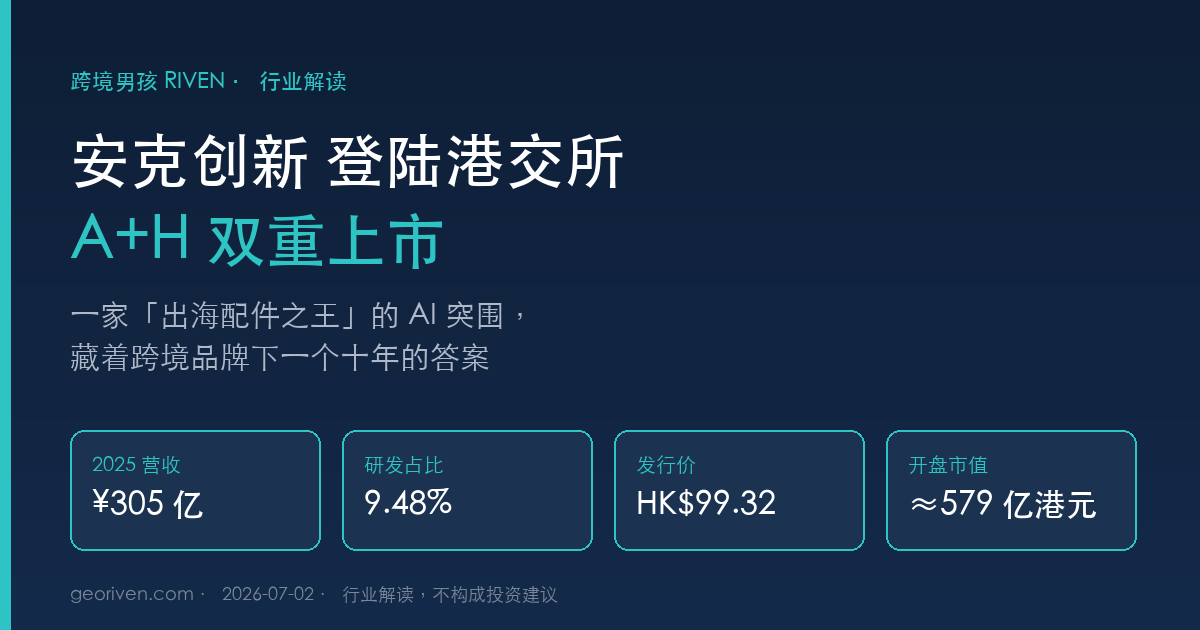
On July 2, 2026, Anker Innovations (00668.HK / 300866.SZ) officially listed on the Main Board of the Hong Kong Stock Exchange, completing an “A+H” dual listing. For most people this is a financial headline; but for anyone in cross-border commerce, branding, or marketing, Anker is practically the textbook of Chinese brand globalization over the past decade — peers even call it the “West Point” of the DTC-出海 world.
As AI rewrites how people discover and choose products, I want to use this moment to take Anker apart: what it got right, what its AI-era ambition is, and — what homework it leaves for every brand and agency still on the globalization road.
1. What Actually Happened Today: The Capital Footnote of “A+H”
Let’s get the facts straight (from public offering materials and the day’s trading):
- Dual listing. Anker was already listed on Shenzhen’s ChiNext (300866); today it adds a Hong Kong listing (00668.HK), completing an “A+H” dual capital platform.
- Offering size. ~46.63M H shares offered globally at an issue price of HK$99.32/share, raising a net ~HK$4.52 billion; the Hong Kong public tranche was oversubscribed ~27.57× and the international tranche ~10.24×.
- Marquee cornerstones. 11 cornerstone investors — including Hillhouse, Schroders, Jane Street, Taikang Life, and UBS Asset Management — subscribed ~HK$2.3B in total.
- Day one. Opening market cap was ~HK$57.9 billion; the stock then broke below its issue price intraday (low near HK$90, about -9%).
Breaking issue isn’t good news, but it points to a more interesting question: why would a company doing perfectly well on the A-share market come to Hong Kong to list a second time?
The answer lives in one word: globalization. Hong Kong is the natural venue for international capital, cross-border settlement, overseas M&A, and talent incentives. For a company that earns 90%+ of revenue abroad and has named “embodied intelligence / edge AI” as its next strategy, A+H isn’t about raising cash — it’s about building an international-capital highway for the second half of its global expansion.
2. Behind RMB 30.5 Billion in Revenue: What Anker Got Right
To understand today, first understand the fundamentals. The 2025 scorecard:
| Metric (FY2025) | Value | YoY |
|---|---|---|
| Total revenue | RMB 30.514B | +23.49% |
| Net profit (attributable) | RMB 2.545B | +20.37% |
| R&D spend | RMB 2.893B (9.48% of revenue) | +37.20% |
| Amazon channel share | 52.29% (57.1% in 2023) | Steadily declining |
| Headcount / R&D staff | 6,304 / 3,549 (56.3%) | — |
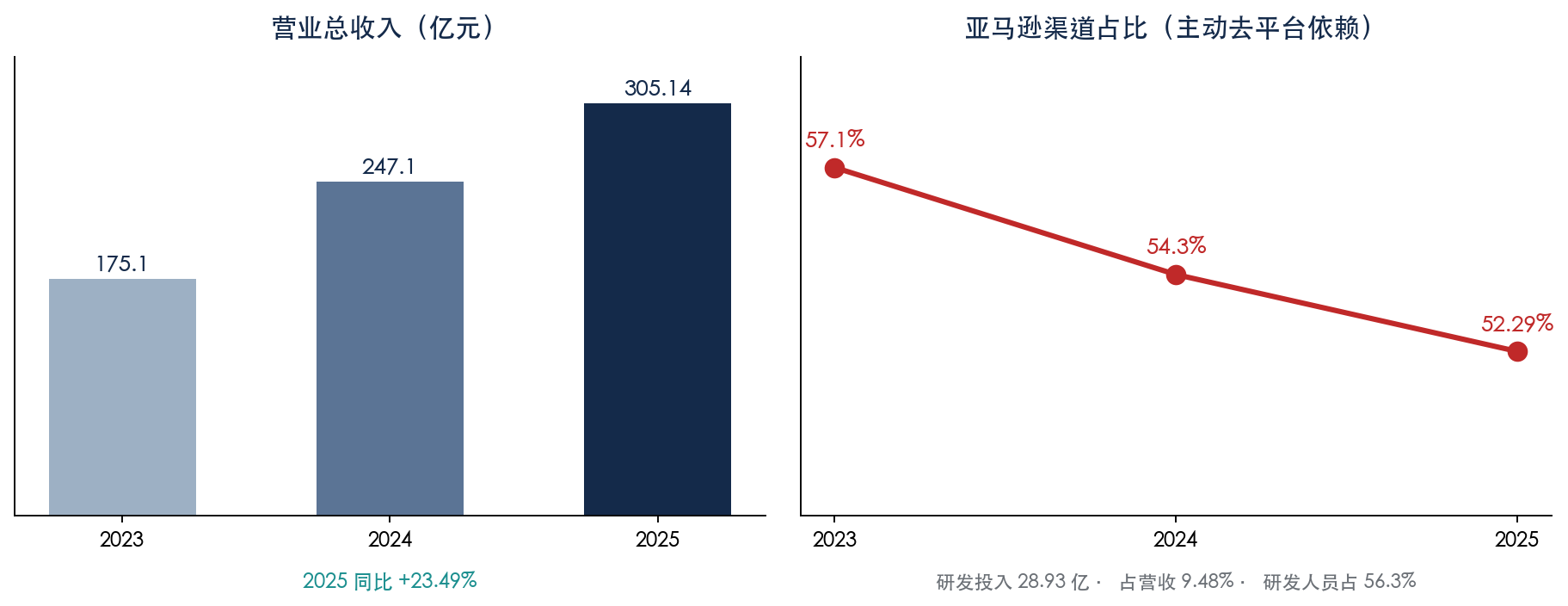
(2023/2024 revenue figures are approximate; 2025 is exact. Chart data compiled by Riven from public annual reports and reporting.)
Three numbers hold the core of Anker’s method:
1) R&D intensity of 9.48%, still accelerating — it is, at its core, a technology company. Visible technical differentiation — GaN fast charging, battery management, acoustic algorithms — is what let Anker turn a commodity like “the power bank” into a premium, repeat-purchase product.
2) Deliberate “de-Amazon-ification” — from single-channel dependence to multi-channel resilience. Amazon’s share fell from 57% to 52% not because Anker sells less, but because DTC storefronts, offline retail, and other platforms picked up the slack. The lesson for any cross-border brand: a platform is a channel, not your brand’s home.
3) A brand matrix, not a one-hit product — one capability, many categories. Anker reuses the same “power + sound + light + intelligence” foundation across three brand domains:
- Anker — charging & energy storage (power banks, GaN chargers, portable power stations, home batteries)
- eufy — smart home & creative tools (robot vacuums, security cameras, smart locks, UV printing)
- soundcore — smart audio (earbuds, speakers)
Together these three domains reach 180+ countries and 200M+ cumulative users. The essence: a brand is a “container of trust.” Product lines can keep growing, but the belief that “if Anker makes it, it’s reliable” is a compounding asset — every new category gets to borrow the trust of the old brand.
3. From “Accessory King” to “Edge-AI Ecosystem”: Anker’s AI-Era Ambition
If the above is about defending, what truly lets Anker tell a new story in Hong Kong is its AI pivot.
At IFA 2025, Anker unveiled a global brand upgrade and pledged to invest ~20% of revenue in R&D over the next three years, focused on edge-AI chips, large models, and robotics. Products are already shipping:
- soundcore (audio): its in-house neural AI audio chip Thus™ A1 delivers ~150× the compute of a conventional Bluetooth chip; the Liberty 5 Pro line built on it earned a Guinness World Record for “clearest calling earbuds.”
- eufy (smart home): the world’s first stair-climbing robot-vacuum assistant MarsWalker, a household-scale LLM agent AI Core (recognizing and predicting 100+ security scenarios), and the AI-driven eufyMake E1 UV texture printer.
- Embodied intelligence: now Anker’s top strategic priority, built on a “software platform + hardware + embodied large-and-small brain” architecture, with a three-step path — from planar robots (vacuums, mowers) to 3D mobile robots (robot dogs, drones), ultimately to humanoids.
In one line: from “powering your devices” to “giving your devices intelligence.”
4. The New Brand Question in the AI Era: When “Being Searched” Becomes “Being Recommended by AI”
Most takes stop at “hardware + AI.” But from a marketing lens, there’s a deeper question: AI isn’t only Anker’s product — AI is also rewriting how every brand gets discovered.
For a decade, the cross-border growth engine was clear: Amazon search + keyword ads + listing optimization + DTC SEO/paid traffic. Users typed into a search box; brands fought for position on the results page.
But today, more and more purchase decisions are migrating from the search box to the chat box — users ask ChatGPT or Perplexity directly: “what’s the best noise-cancelling earbud under $150?” AI no longer returns ten blue links; it hands back a few brand names, a few products, sometimes a shopping card you can buy from.
That’s a foundational shift:
- The definition of visibility changed. From “what’s your search rank” to “are you in the AI’s answer, are you cited, and at what position.” We call this new visibility GEO (Generative Engine Optimization).
- The moat changed. AI’s answers come from the sources it reads — Reddit threads, authoritative review lists, brand-owned content, platform ratings and reviews. Brands like Anker — thick with reviews, content, and reputation — are naturally more likely to be read and recommended by AI. Its decade of accumulated reviews and content is compounding all over again in the AI era.
- But it isn’t automatic. Even Anker can’t assume “big brand = AI recommends me.” Is your product correctly understood by AI? Where do you rank on high-value questions? Which sources feed the AI about you — and are any of them negative? These must be monitored and optimized, just like SEO once was.
For brands still on the road, the AI era is exactly a leapfrog window — because in most categories, AI mindshare is far from claimed.
5. Six Takeaways for Cross-Border Brands and Agencies
- Build technical differentiation into the product, not “low price” into the listing. Surviving a red ocean isn’t about being cheaper; it’s about a difference users can name.
- Never bet the brand’s life on a single platform. A platform gives you traffic, but only your own turf keeps your customer assets and pricing power.
- Use a brand matrix to reuse trust, instead of cold-starting every new category from zero. Let new lines stand on the shoulders of an established brand.
- The second half of globalization is the globalization of capital, talent, and supply chain. A+H is not the finish line — it paves the way for cross-border M&A, incentives, and settlement.
- In the AI era, treat GEO the way you treated SEO ten years ago. Start monitoring now: your brand’s presence rate, rank, citations, and any negative sources across ChatGPT / Perplexity on high-value questions.
- For agencies: your value proposition is shifting from “media buyer/operator” to “architect of a brand’s AI visibility.” Building clients’ AI content assets, source engineering, AI shelf (shopping cards), and GEO monitoring is the most certain incremental service of the next three years.
Closing
From a small team selling batteries on Amazon in 2011, to a globalized AI-hardware platform in 2026 — dual-listed on the A-share and Hong Kong markets, RMB 30B in revenue, now betting on embodied intelligence — the road Anker walked is the road countless Chinese brands dream of.
It proves one thing: Chinese brands absolutely can win premium and respect in the world’s most competitive markets — through technology, brand, and long-termism.
Here’s a sincere congratulations to Anker Innovations on its Hong Kong listing. 🎉
And to every brand and partner still on the globalization road: hold the foundations of your brand, and seize the new window of the AI era — the next “Anker” may well be among those reading this.
Written by Riven. We help cross-border brands get “seen, recommended, and bought” in the AI era (GEO / Agentic Commerce / AI marketing). Data is from public offering materials, Anker’s FY2025 annual report, and public reporting; where discrepancies exist, official disclosures prevail. Not investment advice.