Where Do AI Shopping Cards Get Their Product Data? ChatGPT vs Google AI Mode
By GEOly AI | Data scope: AI-answer monitoring data, through 2026-06
When you ask ChatGPT or Google AI Mode for the “best robot vacuum,” the answer often pops up product cards — with title, price, rating and a buy link. Where does that underlying data actually come from? We ran a large-scale, link-level analysis of shopping cards on both platforms. Here’s what we found.
1. TL;DR
| Dimension | Google AI Mode | ChatGPT |
|---|---|---|
| Product data base | Google Shopping Graph (Google’s own live catalog, 50B+ listings, refreshed ~2B/hour) | No single entry: pulled from “third-party providers” + Shopify/Etsy auto-ingested + a few merchants push feeds directly |
| Merchant entry point | Google Merchant Center (canonical source) + crawled site Schema.org | Nothing required by default (passive inclusion); to control it, apply at chatgpt.com/merchants to push a feed (new, limited) |
| Card link destination | Back to Google Shopping aggregation page | Direct to retailer’s own site (walmart / target / bestbuy…) |
| Link fingerprint | google.com/search?ibp=oshop&prds=… | Almost all carry utm_source=chatgpt.com; virtually none go to Google |
| Rating/review source | Built-in Shopping Graph reviews | Model summary of public web reviews, “not verified” per OpenAI |
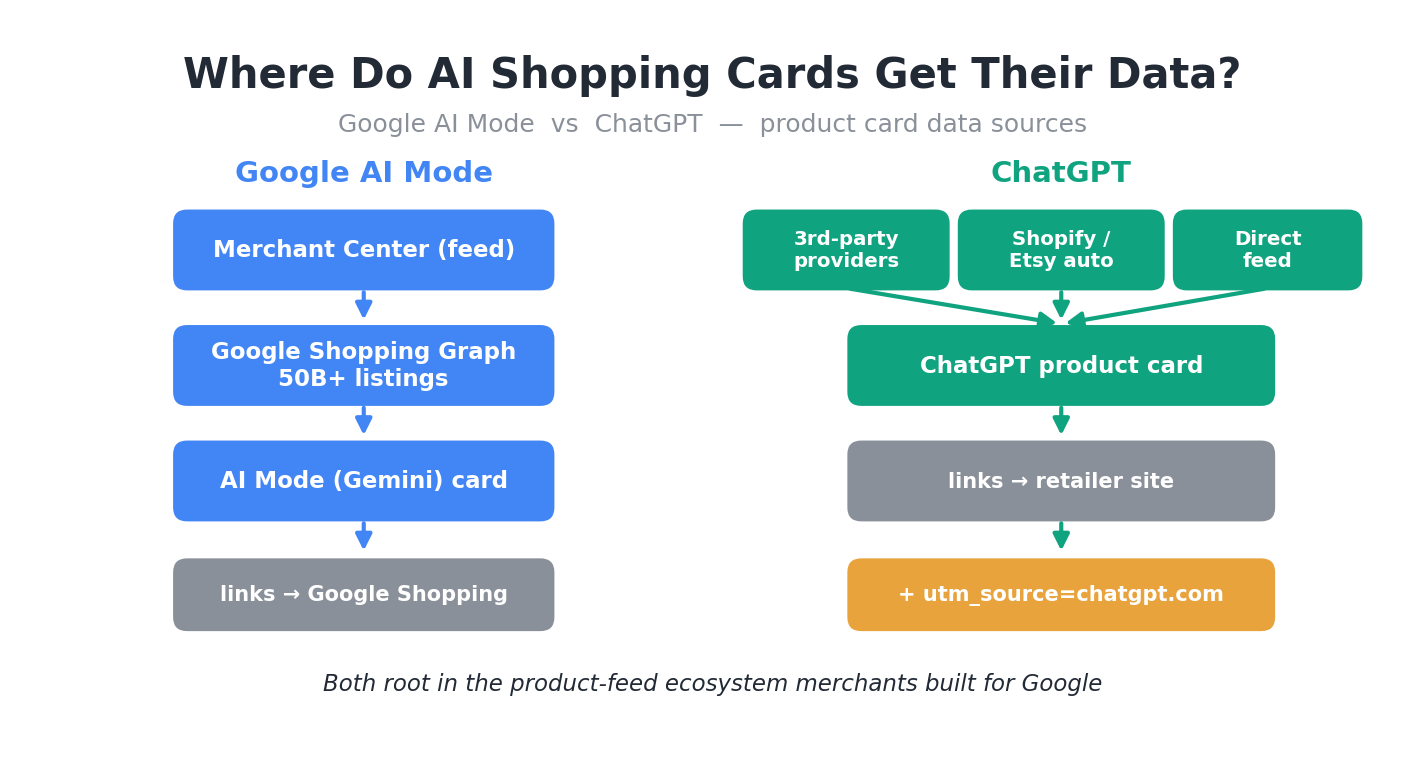
In one line: Google AI Mode reads its own Shopping Graph (single, clear entry = Merchant Center); ChatGPT has no single entry — most products are passively aggregated from third-party providers/platforms, and merchants’ feed links built for other channels (incl. Google Shopping) get reused and stamped with utm_source=chatgpt.com. The two product sources overlap heavily; both are rooted in the feed ecosystem merchants prepared for Google.
2. Google AI Mode — Reads Google Shopping Graph
Source chain
Merchants upload products to Google Merchant Center (feed) → ingested into the Google Shopping Graph (layered with crawled Schema.org product/offer structured data) → AI Mode (Gemini) reads title/price/rating/availability from the Shopping Graph, and cards link back to the Google Shopping product page.
Evidence
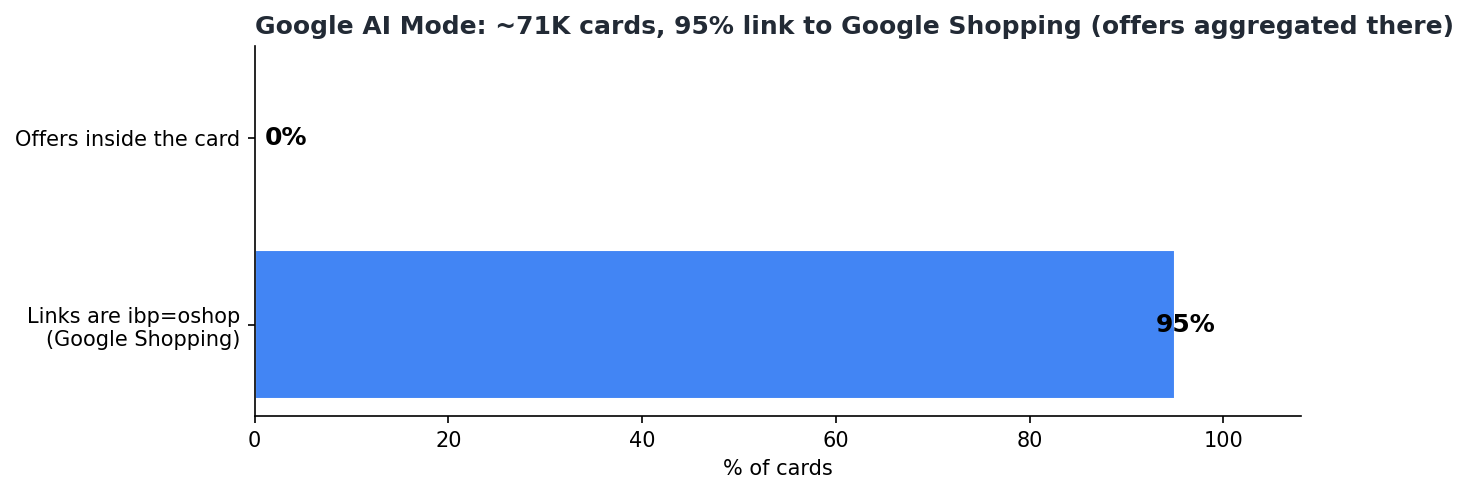
- Link fingerprint: across ~71K Google AI Mode shopping cards in the last 7 days, 95% of links look like
google.com/search?ibp=oshop&prds=…,gpcid:<id>,catalogid:<id>,productDocid:<id>,…. Heregpcid= Google Product Catalog ID;catalogid/productDocid= Shopping Graph entity IDs. Offers aren’t in the card — they’re aggregated on Google’s own Shopping page. - Independently identifiable format:
ibp=oshopis a well-known Google Shopping product link format. - Official statements: Google (blog.google I/O 2025, Think with Google) states AI Mode shopping = Gemini + Shopping Graph (50B+ listings, ~2B/hour refresh, including reviews/prices/availability).
- Single entry: independent analyses (Productsup / Feedonomics) note Merchant Center feed is the canonical entry to the Shopping Graph.
Confidence: High (official + independently identifiable link format).
3. ChatGPT — No Single Entry, Reuses Merchants’ Existing Feed Ecosystem
Source chains (three coexist)
- ① Default: merchants do nothing — OpenAI obtains product metadata via third-party data providers/aggregators (official wording: “third-party providers”; the specific provider is not named publicly).
- ② Platform auto-ingest — Shopify / Etsy merchant catalogs are auto-connected by OpenAI, zero setup.
- ③ Merchant push (new, limited) — apply at
chatgpt.com/merchants→ review → OpenAI provides a dedicated secure endpoint → merchant pushes a feed (JSONL/CSV/TSV/Parquet, explicitly “not crawled,” refresh as fast as every 15 min). Instant Checkout (via Stripe + ACP) is an extension of this.
Evidence
-
Direct retailer links: across ~1.26M ChatGPT cards, the top link domains are all retailers’ own sites (walmart / homedepot / target / bestbuy / lowes / etsy / wayfair / ulta / nordstrom / chewy / sephora / macys…). The
websitein many in-card offers is also a real retailer name.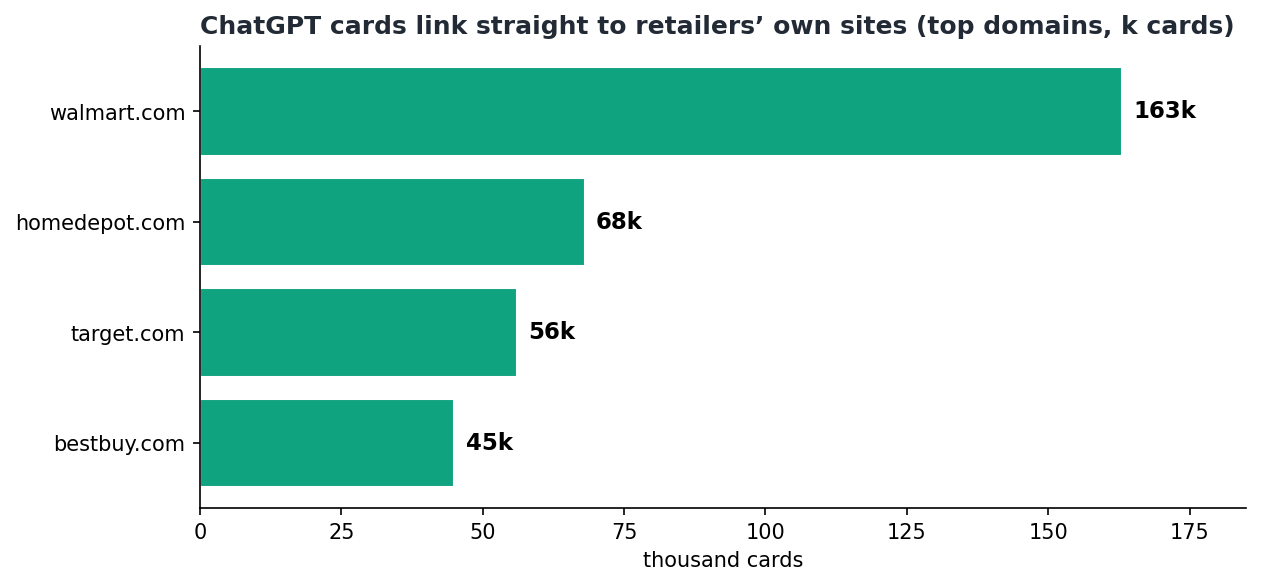
-
utm_source=chatgpt.comis appended by OpenAI: ~99.97% of linked cards carry this parameter; virtually none go to Google. This behavior has been independently observed in real browsers + GA4 across the analytics community (Lawrence Hitches, Seer Interactive) — “OpenAI auto-appends this parameter to outbound links.”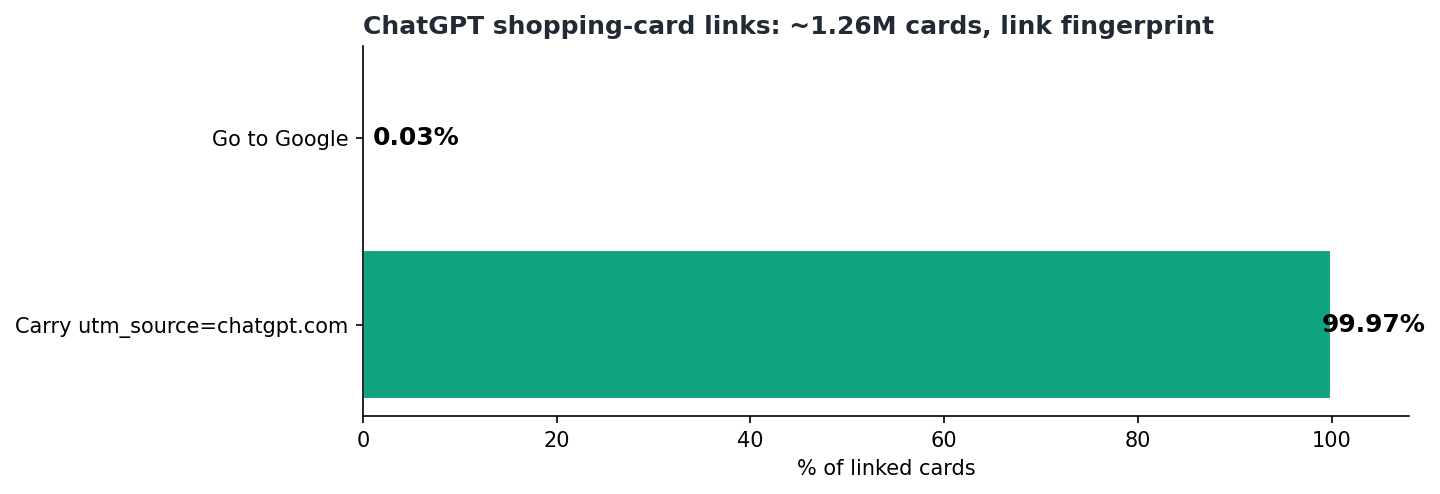
-
Merchants’ own UTMs leak, revealing the original channel:
utm_mediumvalues are all over the place, and ~69% have no medium at all; the rest are merchants’ own marketing naming, not a unified OpenAI field:Merchant’s original channel The raw marker in the link Example Google Shopping / Merchant Center utm_medium=organic_pla(Google PLA term)Chewy A feed built specifically for OpenAI utm_campaign=genai_shopping/utm_medium=openaifeed/utm_campaign=chatGptProductFeedNordstrom, Macy’s, Scheels Pushed by a feed-management platform utm_medium=feedonomics&utm_campaign=openai_11carparts.com Generic feed / referral utm_campaign=feed&utm_medium=referralBackcountry 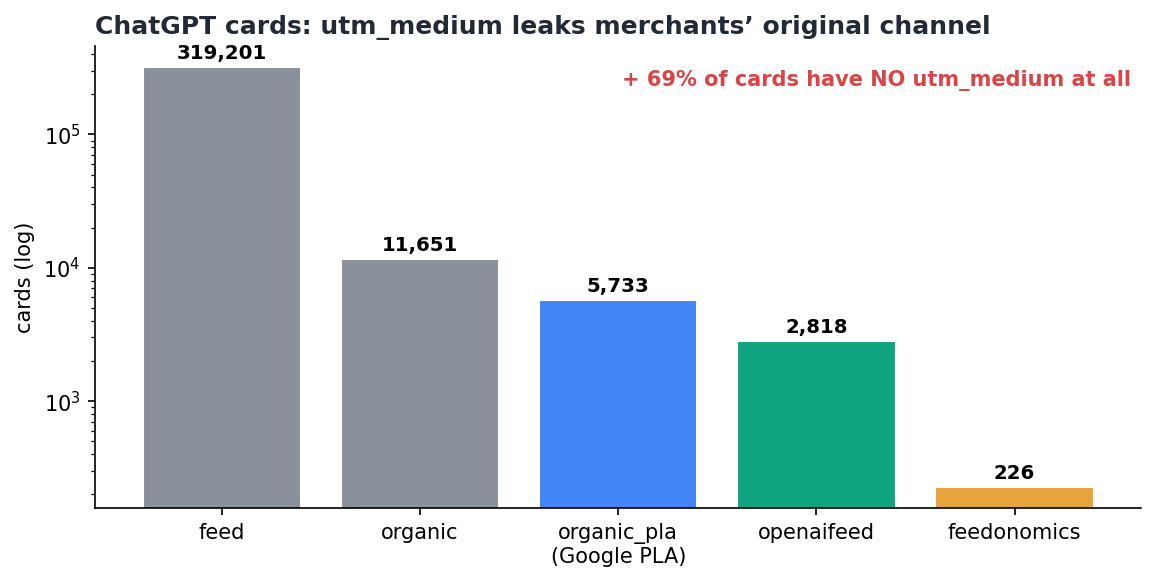
-
“Double utm_source” (small sample): the merchant’s original Google tracking is still there, with
chatgpt.comstacked on top — showing these links were originally configured by merchants for Google and reused by OpenAI. -
Official statements: OpenAI (help center / Powering Product Discovery): products/prices come from “first-party and third-party providers”; review summaries are model-generated from “public website reviews” and “not verified by OpenAI”; Shopify/Etsy auto-ingested; other merchants can apply to push feeds; results are organic, not ads.
Confidence
- “Direct retailer links +
chatgpt.com, not Google”: High (large first-party sample + independent real-browser observation). - “Three paths exist — third-party provider / Shopify-Etsy / direct feed”: High (OpenAI official).
- “Which path dominates”: Unknown — UTM is not a reliable source label; current data can’t quantify it.
- “Mostly reuses Google Merchant Center feed ecosystem”: Medium — merchants’ old feed links clearly bleed through in volume, a few explicitly carry Google/PLA markers, but we can’t assert the main source is Google; it could be neutral aggregators or even Bing/Microsoft.
4. What It Means for Brands/Merchants
- On the ChatGPT side there is no single, public, open entry — most brand products are passively included via third-party providers (quality and attribution out of your control), while pushing directly via
chatgpt.com/merchantsis still blue ocean. On the Google side, it’s the mature Merchant Center battlefield. - “Getting on the ChatGPT shelf” ≠ “getting on the Google AI Mode shelf” — they are two independent motions: the former means getting correctly ingested by third-party providers + evaluating a direct feed push; the latter means cleaning up your Merchant Center feed and site Schema. The two shelf channels should be diagnosed and operated separately.
- The common foundation is the merchant’s product feed ecosystem: the quality of your feed’s titles/prices/availability/structured data directly determines your visibility and buyable-card completeness on both AI shelves.
Method & Scope
- Based on large-scale, link-level analysis of shopping cards inside both platforms’ AI answers (millions of ChatGPT cards, tens of thousands of Google AI Mode cards, US, through 2026-06).
- Link fingerprints (
ibp=oshop,utm_source=chatgpt.com) are corroborated by independent sources: the well-known Google Shopping link format and real-browser GA4 observation. - Boundary: the exact share of each source path cannot be quantified from links alone; “is ChatGPT’s main source Google feed?” is rated Medium confidence — we avoid over-claiming.
Sources
- OpenAI: Shopping with ChatGPT Search | Powering Product Discovery | chatgpt.com/merchants
- Google: Shopping AI Mode (blog.google, I/O 2025) | Think with Google
- Independent observation: Lawrence Hitches (utm_source=chatgpt.com explained) | Seer Interactive (tracking AI traffic) | Productsup (inside Google AI Mode) | Feedonomics