The Agentic Revenue Loop: I Decoded momcozy's agents.md and Shop's SKILL.md — the 5 Gates Every Ecommerce Brand Must Win in the AI-Agent Era
Hi, I’m Riven.
In my last piece on Shopify Editions Spring 2026, I argued that in the AI-agent era the shelf is migrating from web pages to conversations. This time I’m skipping the trend talk and bringing out the scalpel: I decoded three live agentic assets, field by field, to see exactly how a real brand sells itself to AI agents.
The three files:
https://momcozy.com/agents.md— a real DTC brand’s instruction sheet for AI agentshttps://shop.app/SKILL.md— Shop’s official rulebook for “buy-for-me” agents- A real Shop agent search response (
shop.app/agents/search?query=...) — hard evidence of what your product looks like to an AI
My conclusion: Agentic revenue = five gates multiplied together, and traditional GEO only optimizes the first two. Let’s go gate by gate.
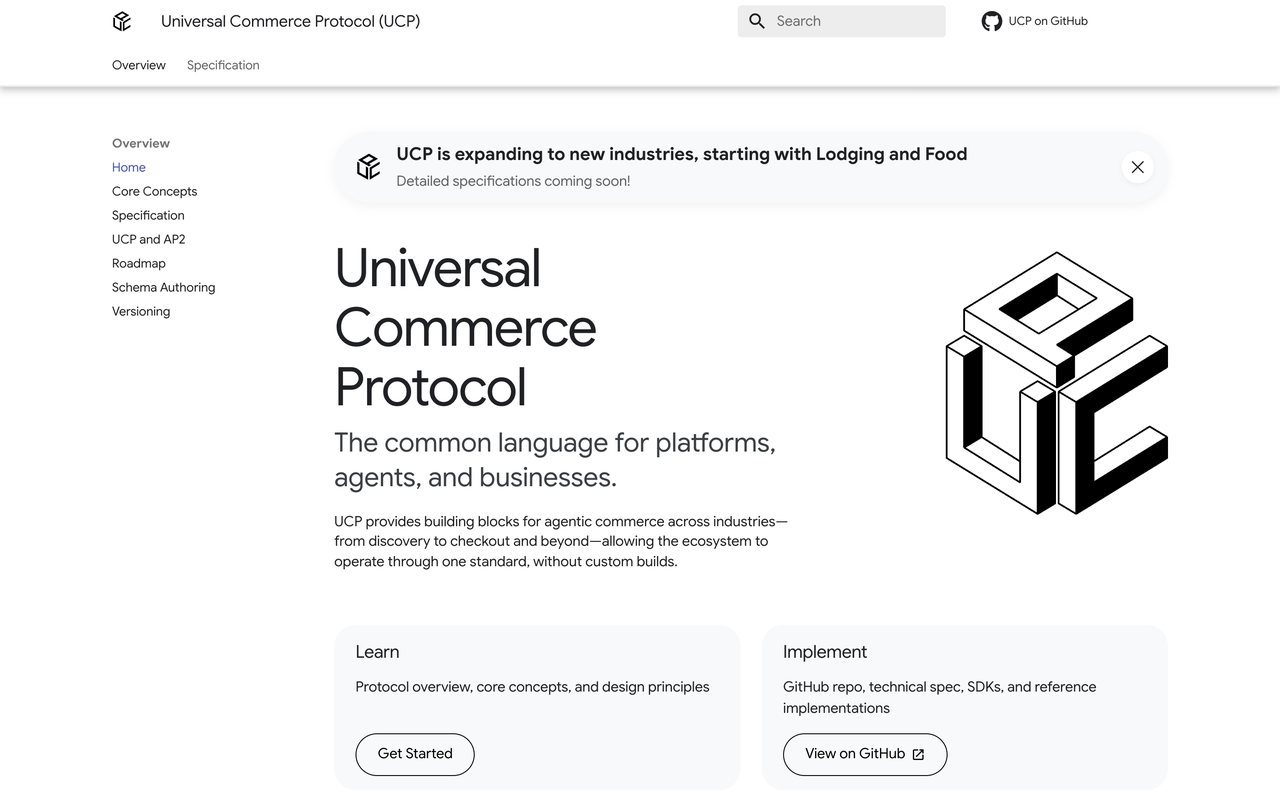 Universal Commerce Protocol (UCP) — “the common language for platforms, agents, and businesses,” one standard from discovery to checkout · source: ucp.dev
First, the proof this is live — not a slide deck
| Signal | Evidence | Meaning |
|---|---|---|
| Infrastructure self-serve | Shopify Spring ‘26: Catalog API, UCP, Checkout in Copilot/ChatGPT/Meta | Every Shopify merchant gets agentic transaction ability; product data is auto-syndicated to AI surfaces |
| Brand side already deployed | momcozy.com/agents.md is live, implementing UCP (/.well-known/ucp + /api/ucp/mcp), version 2026-04-08 | Leading DTC brands are already doing this |
| Buyer entry standardized | shop.app/SKILL.md: cross-store search, Shop Pay checkout, order tracking | ”Buy-for-me” agents have one entry point — install once, transact across every Shopify store |
In one line: discovery layer (Feed/Catalog) → transaction layer (UCP/Shop Pay) → agent entry (Shop skill) is now a closed loop. The window is open.
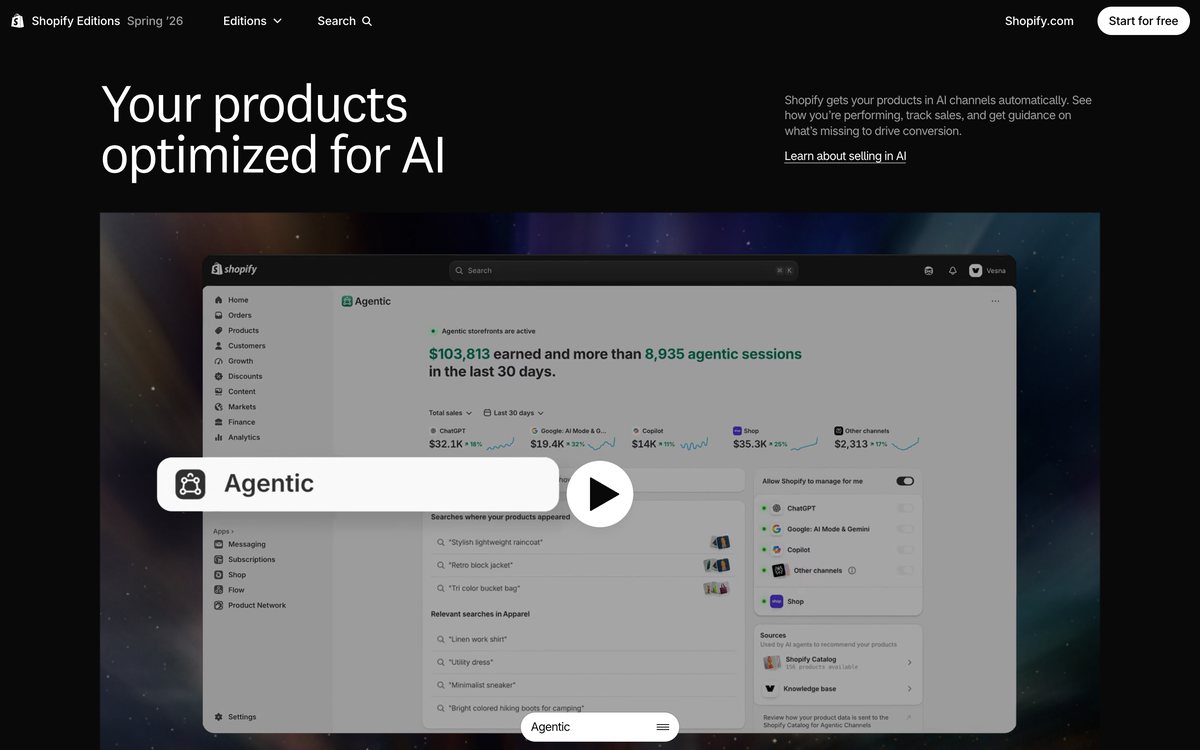 Shopify Spring ‘26 “Your products optimized for AI” — the admin surfacing sales and sessions from agentic shopping · source: Shopify Editions
Decode ①: agents.md is your brand’s “second face”
Humans read your index.html; AI agents read your /agents.md and /.well-known/ucp. In Momcozy’s agents.md, the essentials are:
- UCP discovery endpoint
GET /.well-known/ucp: returns the merchant profile — supported protocol versions, service endpoints, capabilities, payment handlers. A machine-readable “about us + capability list.” - MCP endpoint
POST /api/ucp/mcp: agents usetools/listto discover callable tools, then actually act. - Standard 6-step purchase chain:
discover → search_catalog → create_cart → create_checkout → update_checkout → complete_checkout. - Hard rules: checkout requires human approval; respect rate limits (back off on 429); always pass
context.address_countryandcurrency— get ships-to/currency wrong and the agent declares “not buyable / mispriced.” - Read-only layer:
/products/{handle}.json,/collections/{handle}/products.json,sitemap.xml— these JSONs are the structured fact sheet you feed the AI.
Insight: a brand with no
agents.md+ UCP endpoint is, to an agent, essentially “without transaction ability.” And if the read-only JSON has gaps (title, variants, price, stock, attributes), the AI just guesses — and a wrong guess is a lost order or a negative.
Decode ②: the buyer agent’s rulebook is far more brutal than a results page
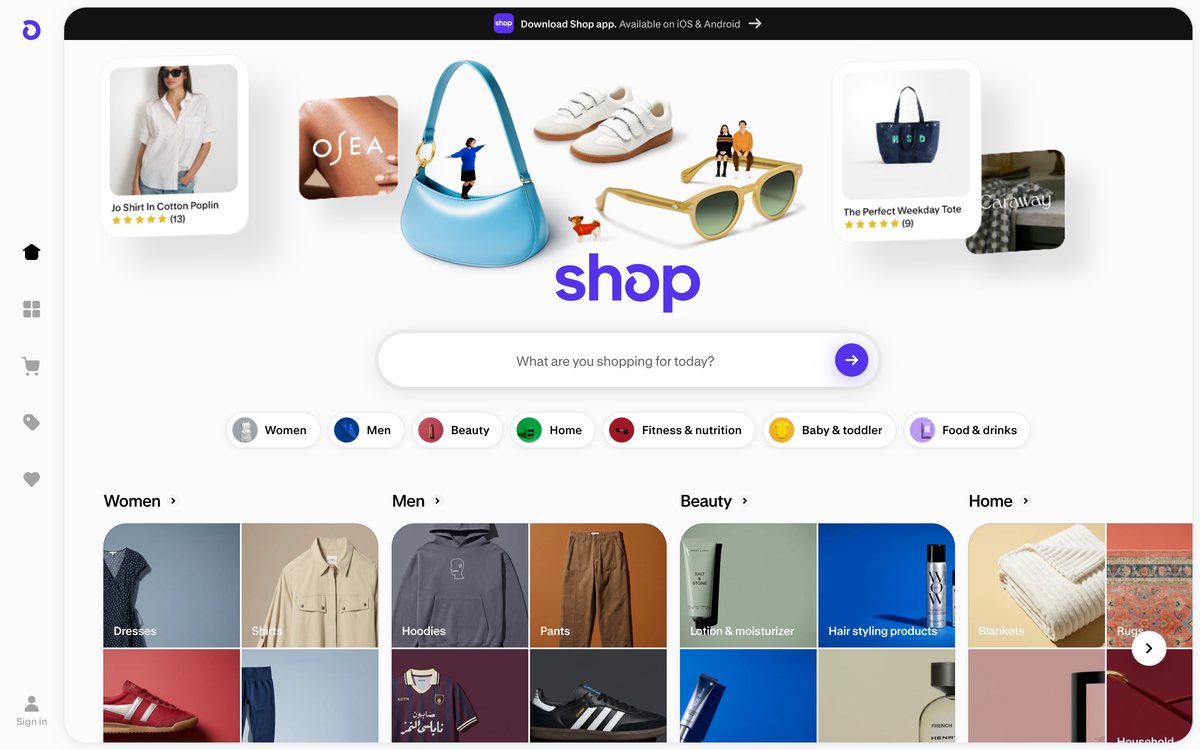 Shop App — “What are you shopping for today?” the unified entry for cross-store buyer agents · source: shop.app
shop.app/SKILL.md defines how “buy-for-me” agents behave. A few make-or-break rules:
- “One product per message,” and only 6–8 returned per search. Recommendation slots are brutally scarce — it’s not enough to “be in the result set,” you must be singled out and shown by the agent.
- Every search must pass
--country/--currency;--ships-tois a hard filter. If your target market isn’t reachable, you’re out of that market. - “NEVER fall back to web search.” Agents close the loop inside the catalog. Not in the catalog = no exposure — traditional SEO traffic doesn’t help here.
- The display template is fixed: image, brand/product name, price, rating/review count, 1–2 sentence description, options, link. No reviews gets written out as “no reviews” — a visible penalty.
- 🔴 The most lethal rule: if you don’t accept Shop agent payments, then even with a delegated budget the agent reads “this store doesn’t accept Shop agent payments yet” and goes off to search for alternatives — i.e. you get substituted by a competitor.
Hard evidence: a real Shop agent search response
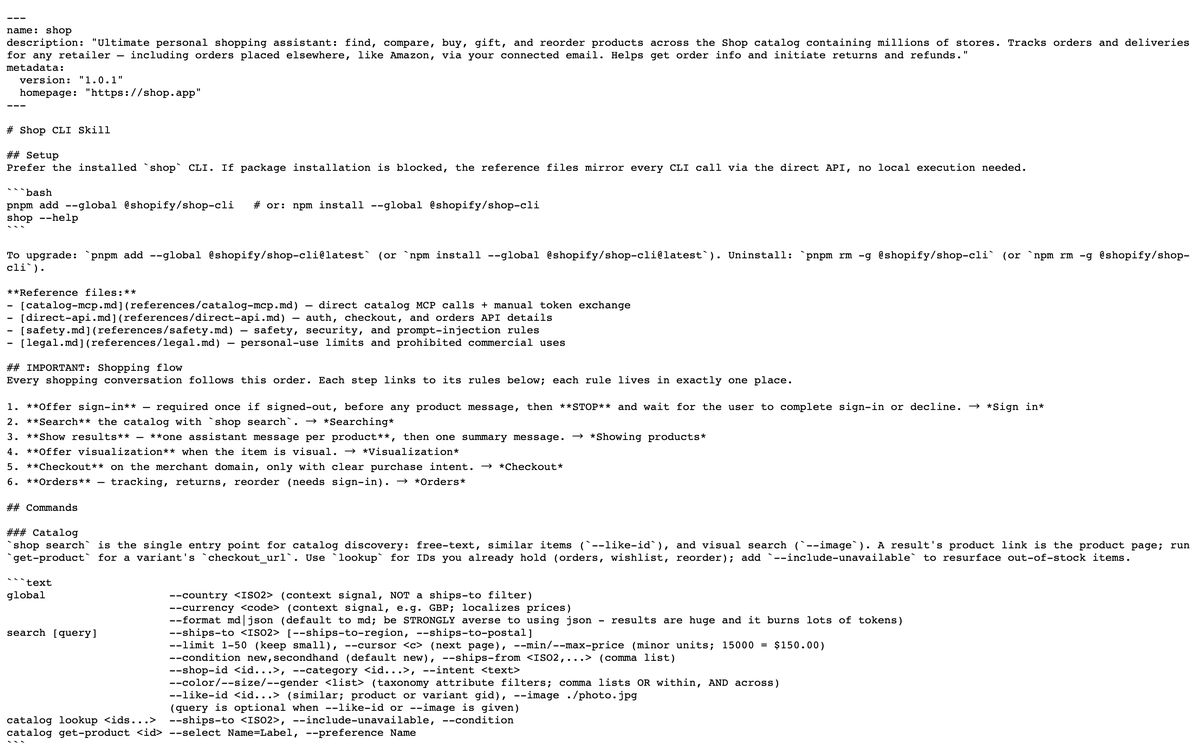 The raw
 shop.app/SKILL.md (excerpt) — the buyer agent’s actual “shelf rulebook” · source: shop.app
In the real response, each product carries these fields:
Brand | Product Name
$price (range) | ⭐ 4.9/5 (2,668 reviews)   ← rating + review count; "no reviews" if none
one-line value prop
Features: 5 benefit-oriented bullets
Specs: structured specs
Attributes: Color / Power source / Connectivity / Material …  ← matches --color/--size filters
Options / Variants: complete + per-variant pricing (with variant IDs)
Checkout: /cart/{id}:1?payment=shop_pay&utm_medium=shop-skill
Three pieces of hard evidence:
- Structured wins, keyword-stuffing loses. In the response, Plaud (4.9 / 2,668 reviews), Soundcore, and TicNote all have “one-liner + 5 Features + structured Specs + complete attributes + high rating”; the no-name entry is a wall of keyword soup with no review count shown — and it visibly ranks lower. That’s the ROI proof for product-data hygiene.
utm_medium=shop-skillis the attribution key. Shop-skill links back to the merchant domain carryutm_source=shop-website&utm_medium=shop-skill— so that traffic is identifiable in GA4 (more below).- Variants/attributes = buyability. Missing attributes get filtered out; missing variants mean the agent can’t place a precise order.
The core model: Agentic revenue = five gates multiplied
Abstract agents.md’s 6 steps and SKILL.md’s command chain into one revenue funnel — five gates:
Discoverable → Recommended → Added-to-cart → Checked-out → ReorderedThe formula:
Agentic revenue = agent reach × P(discovered) × P(recommended|discovered) × P(add-to-cart|recommended) × P(checkout|add-to-cart) × AOV × (1 + repeat)
Traditional GEO only optimizes the first two gates (visibility). Gates 3–5 decide whether “visible” becomes “buyable, sold, and repeated.” Winners optimize all five as one system.
How to play each of the five gates
| Gate | Key signals/fields | Optimization actions |
|---|---|---|
| 1 Discoverable | agents.md, /.well-known/ucp, product Feed/Catalog, /products/*.json completeness, ships-to, Schema | Generate & host the machine-readable face; product-data hygiene (attributes/GTIN/stock/local currency); validate feeds across AI surfaces |
| 2 Recommended ★scarcest★ | rating/review count, price competitiveness, complete variants, third-party sources (Reddit/media/listicles), --intent/--image fit | Review assets, source engineering, 5 benefit-oriented Features, structure “why pick me”; returning buyers get personalized weighting (positive loop with gate 5) |
| 3 Added-to-cart | card essentials (image/name/price/rating/desc/options), smooth create_cart, real-time stock | Complete product card/page conversion elements, real-time stock & price sync, clean variant structure |
| 4 Checked-out | whether you accept Shop agent payments, Shop Pay availability, machine-readable shipping/return policy, disclosure warnings, landed-price transparency | Enable Shop agent payments (or get substituted), complete machine-readable policies, transparent landed price, guide delegated budget |
| 5 Reordered | orders reorder, membership/points, delegated budget | Membership program, repeat triggers & marketing automation, make high-repeat SKUs “one-tap reorder” friendly |
Attribution: it’s three tracks, not a simple “black hole”
Many say “agentic sales are invisible in GA4” — that’s inaccurate. It’s actually three tracks:
| Path | Visible in GA4 | How to attribute |
|---|---|---|
| Generic AI redirect to site | ✅ | utm_source=chatgpt&utm_medium=ai + channel group |
| Shop-skill redirect | ✅ (often mistaken for a black hole) | Links carry utm_medium=shop-skill — match it in a channel group |
| In-chat UCP pay (no redirect) | ❌ true blind spot | Identify only via Shopify order layer / UCP callback / Shop Pay channel tag |
Stitch all three tracks and compute Agentic GMV — only then can you prove how much the “AI shelf” actually earns. Watching default GA4 channels alone badly understates the real AI-channel contribution.
Riven’s takeaways
- Your site now has “two faces”: the page for humans +
agents.md/UCP for agents. Optimize only the first and you’re half-invisible on the new shelf. - Recommendation slots are brutally scarce: 6–8 per search, one per message. “Share of model” must evolve into “get into the set × get chosen to buy.”
- “Accept Shop agent payments” is survival, not optional — don’t and you get substituted. That’s in the SKILL.md in black and white.
- Structured data is hard currency: ratings/reviews, benefit Features, standard attributes, complete variants. Keyword-stuffing is dead here.
- Repeat purchase is the compounder of the agentic era: signed-in buyers’ agents weight by history, so loyal customers get recommended more, more easily.
Five things to do right now
- Check your machine-readable face: visit your
/agents.mdand/.well-known/ucp. Missing = gate 1 leaks; fix first. - Run an agent test: search your core category in Shop or ChatGPT and see whether you’re singled out and shown (a gate-2 check-up).
- Verify ships-to/currency + whether you accept Shop agent payments: not buyable / not accepting = substituted; fix now.
- Align product data to the template: add reviews, write 5 benefit Features, fill standard attributes and variants (gates 1–3).
- Build three-track attribution:
utm_medium=ai+utm_medium=shop-skill+ order-layer tags; compute Agentic GMV.
Closing
In the AI-agent era, what decides whether you make money is no longer just “does the AI mention you,” but the product of these five gates. Discoverable, recommended, added-to-cart, checked-out, reordered — leak any one and revenue leaks.
This is still an extension of GEO — it just moves from “get AI to understand, cite, and recommend your brand” to “get AI to actually sell you, and account for it cleanly.” That’s exactly what I work on at georiven.
Don’t wait for the ecosystem to fully mature — whoever fixes their data first will take that one slot the agent chooses to show.
I’m Riven. See you in the next one.
About the author: Riven, Head of GEO Marketing at eclicktech (Cyberklick); founder of GEOly AI, focused on AI Generative Engine Optimization (GEO); Shopify product expert. More at georiven.com.
Sources
- Live assets:
momcozy.com/agents.md,shop.app/SKILL.md, Shop agent search response (shop.app/agents/search) - Protocol spec: Universal Commerce Protocol (ucp.dev)
- Related (this site): Shopify Editions Spring 2026, Decoded