AI Now Places the Order for You: A Deep Dive into Agentic Commerce and the Next Decade of Brand E-commerce
I’m Cross-border Riven. After years in cross-border e-commerce and brand globalization, I rarely use the word “inflection point” — it’s been worn out. But this time I’ll say it plainly: Agentic Commerce is not just another traffic fad. It’s an operating-system-level upgrade to e-commerce. Whoever understands the mechanics first gets the ticket to the next decade.
Let me start with something that’s already happening.
My mom — the kind of person who finds shopping apps too much hassle — now just asks an AI: “Find me a portable power station for camping, one that can run a hair dryer, with a long cycle life, under $400.” Seconds later the AI returns three models, with a spec comparison, prices, ratings — even a product card she can tap to buy, or pay for right inside the conversation. She never opened a shopping app, never scrolled a single ad, never compared ten stores.
This is Agentic Commerce: instead of a person browsing stores, an AI agent handles the entire “discover → compare → decide → buy” journey on their behalf.
For consumers, it’s convenience. For those of us who build brands and sell across borders — it’s the sky falling, and the dawn breaking, at the same time.
1. The core shift: whose mind are you actually changing?
For twenty years, e-commerce ran on one sentence: put your goods where people go, then pay for exposure.
Whether it was optimizing Listings and buying CPC in the Amazon era, or running Facebook/Google ads and chasing ROAS in the DTC era — there was always a human in the middle, personally browsing, searching, comparing. Every marketing move you made was aimed at influencing that human.
Agentic Commerce removes that premise. This one picture says it all:
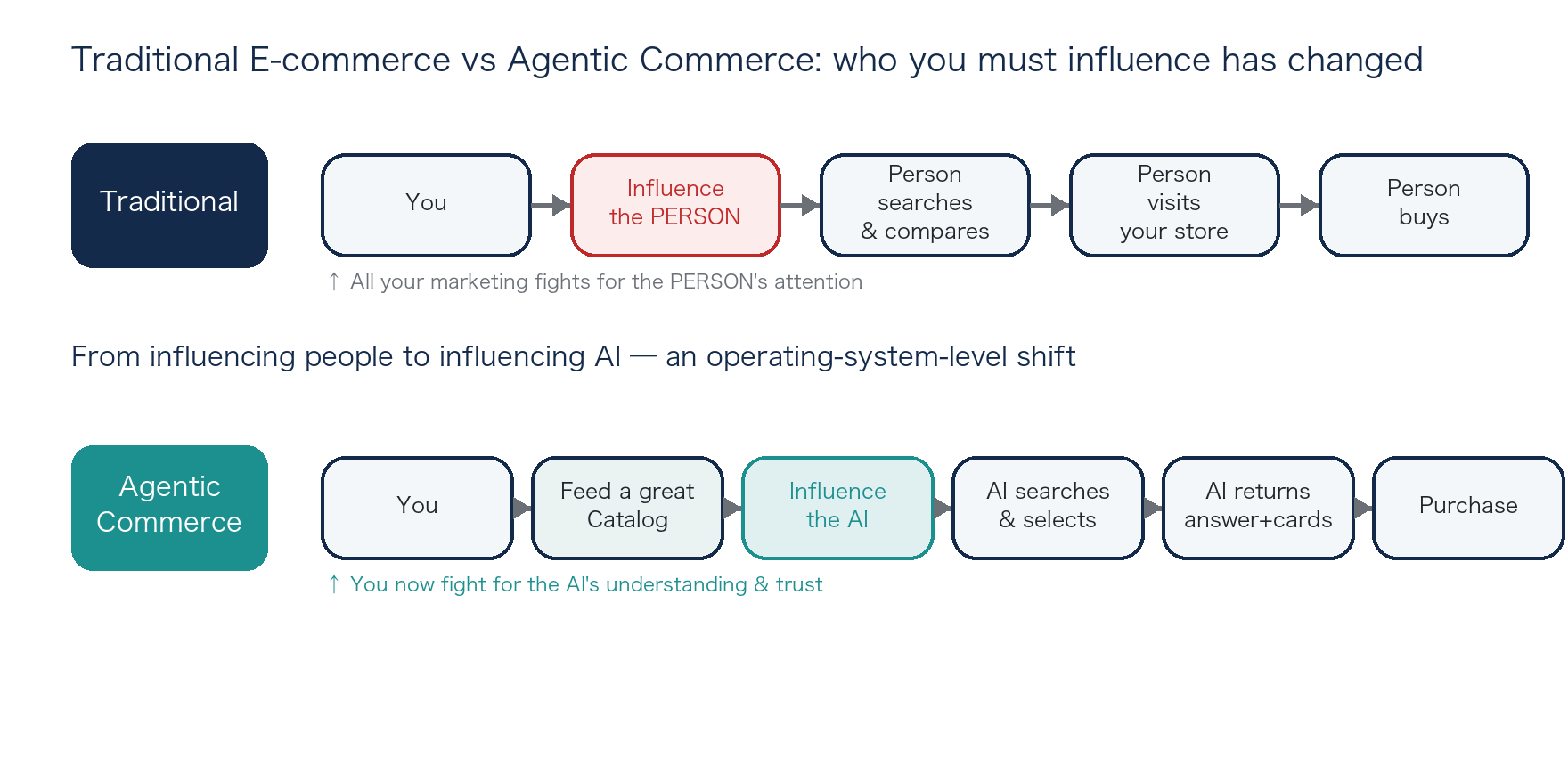
Traditional e-commerce vs Agentic Commerce — who you must influence changes from the person to the AI.
One line to sum up the nature of this upgrade:
The battlefield of e-commerce is migrating from “shelf + traffic” to “the AI’s answer + the AI’s trust.” The target you must influence changes from the person to the AI.
2. The mechanics: how a product enters an AI answer — and gets bought
This is the most important section. Many people assume “the AI crawls my website.” Wrong. The real mechanism is that you feed it — you don’t get crawled. Here’s the full chain:
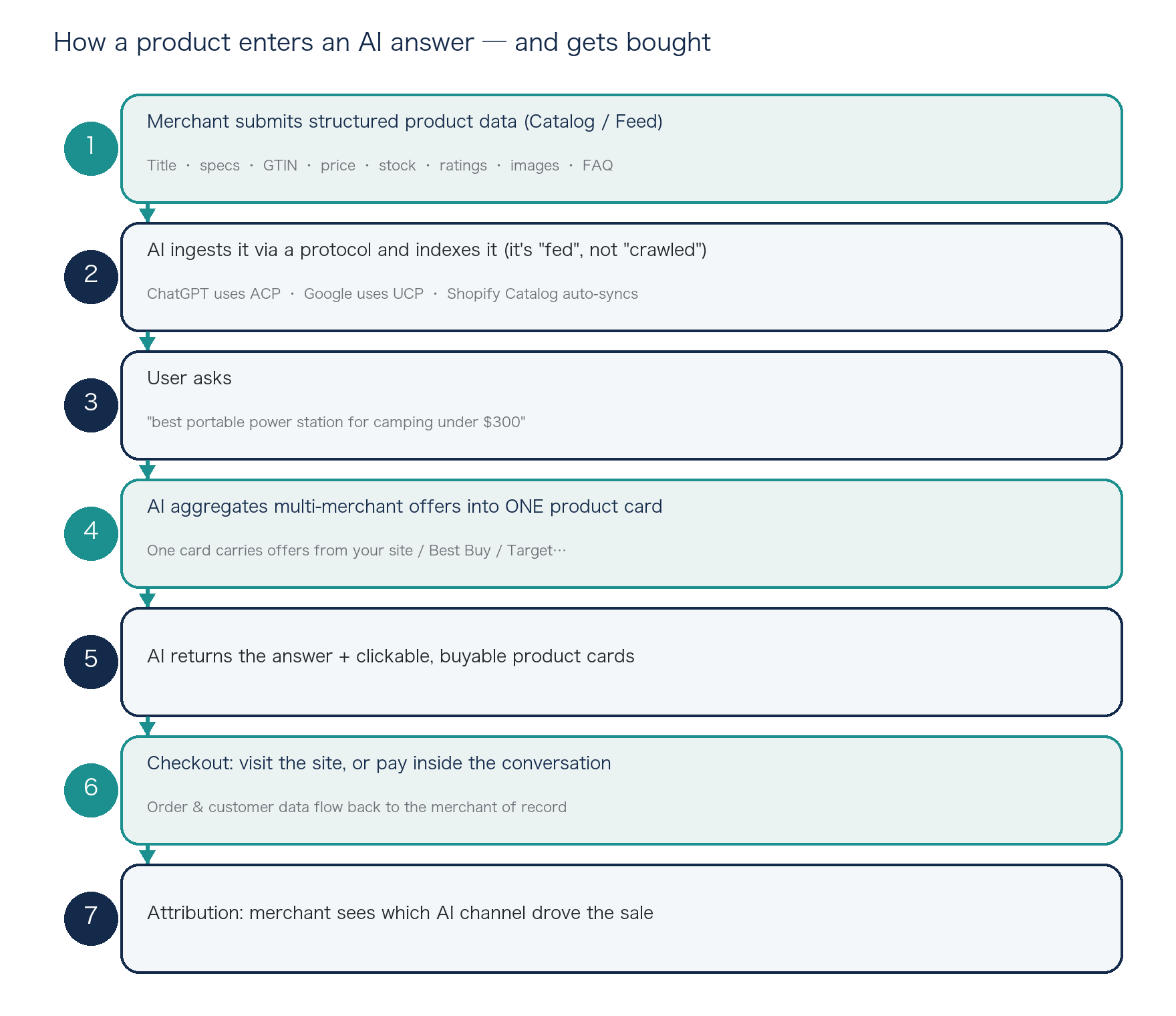
How a product enters an AI answer — and gets bought — end to end.
Three make-or-break principles are hidden in this flow:
Principle 1: It’s “fed,” not “crawled” — so traditional SEO crawling barely helps. The AI doesn’t read your page HTML; it reads the structured fields you submit. Specs buried inside image-and-text descriptions are invisible to it. Only when specs live in structured data (metafields / feed fields) can the AI compare them item by item and dare to recommend you. That’s why “Catalog data quality” is the new fundamental.
Principle 2: The product card is “aggregated” — your own site is just one of many offers. Step ④ is the crux. The AI often doesn’t show your website page; it aggregates the offers for the same product from across the web into a single card. Whether you become the offer that gets clicked and bought depends on your data completeness and price competitiveness. This is why so many brands are “seen but don’t earn” — they win exposure, but the sale gets intercepted by retailers.
Principle 3: Checkout moves into the conversation — the last mile gets rewritten. Instant Checkout in step ⑥ means conversion no longer hinges on how pretty your landing page is, but on whether your product data, offers and inventory can be cleanly called by the AI in real time.
3. The protocol race is already decided: the highway is being paved
What exactly are these “protocols”? Simply put, they’re the standard interface between “the merchant’s goods” and “the AI’s mouth.” Two open camps have formed:
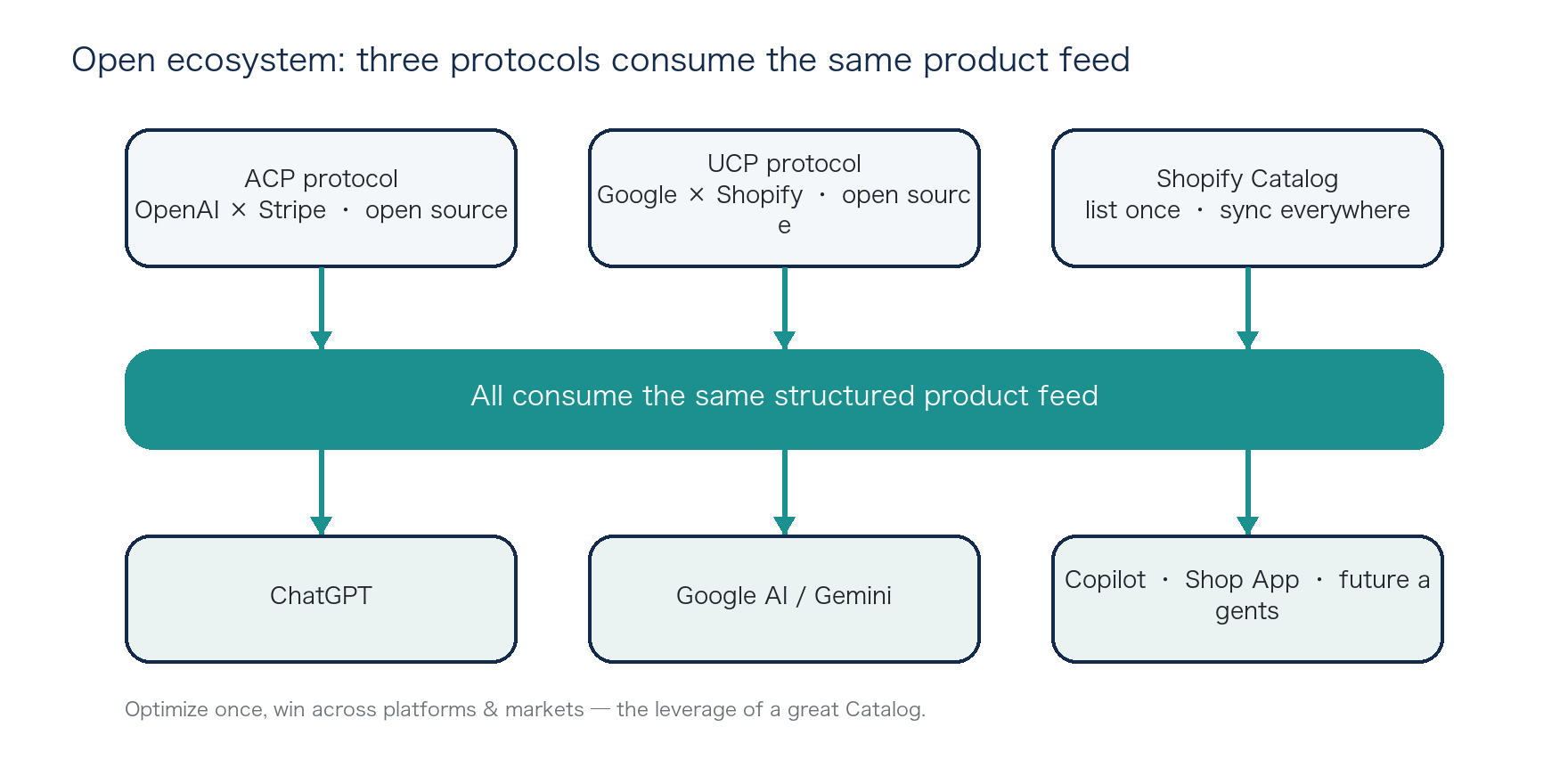
The open ecosystem — ACP, UCP and Shopify Catalog all consume the same structured product feed.
| Protocol / channel | Led by | Key point |
|---|---|---|
| ACP (Agentic Commerce Protocol) | OpenAI × Stripe | Open source; merchants submit a feed into ChatGPT, checkout inside the conversation |
| UCP (Universal Commerce Protocol) | Google × Shopify | Open source; discovery → checkout → post-purchase, compatible with AP2 agent payments & MCP; endorsed by 20+ retail/payment giants |
| Shopify Catalog | Shopify | List once, auto-sync to ChatGPT / Copilot / Shop App and every current and future channel |
A few reality-check numbers (all from public sources, 2026):
- ChatGPT monthly actives are on the order of 880 million — a bigger “shelf” than any single e-commerce platform.
- Since March 2026, eligible Shopify stores appear inside ChatGPT by default, no plugin required.
- AI-referred traffic to Shopify grew about 7× in a year; AI-attributed orders grew about 11×.
- And the sharpest move: Shopify launched the Agentic Plan — even if you don’t build on Shopify (SAP, custom, ERP), you can list your products in its Catalog and plug into these AI channels.
The road is built, the tollbooth isn’t up yet, and the window is at most 6 to 18 months.
4. But there’s one exception — the biggest one: Amazon is playing a “closed-loop” game
We have to pause here to correct a signal that’s easy to misread.
Using GEOly’s monitoring database, we pulled real data: in ChatGPT’s product cards, Amazon appears 0 times. Across tens of thousands of merchant offers spanning every category, Amazon shows up not once.
Many people’s first reaction is “Amazon has fallen behind in the AI era.” Dead wrong. The opposite is true — Amazon is staying out on purpose, because it’s building its own walled garden.
Amazon deliberately skipped ACP, UCP and even MCP, taking the exact opposite path: making agentic commerce an internal closed loop of its own.
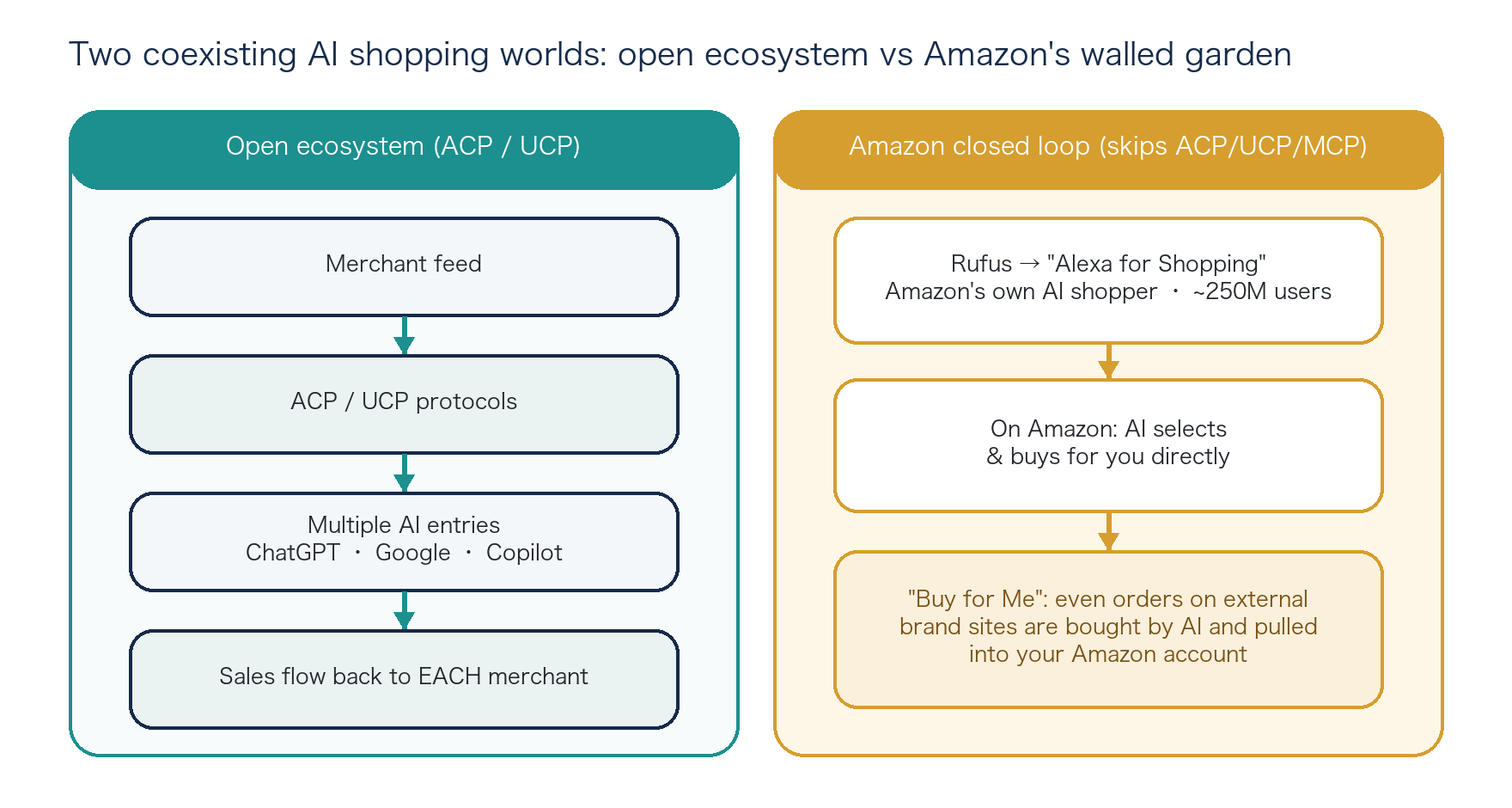
Two coexisting AI shopping worlds — the open ACP/UCP ecosystem vs Amazon’s walled garden.
- Rufus / “Alexa for Shopping”: Amazon’s own generative AI shopping assistant, already serving roughly 250 million users, completing “discover → recommend → buy” inside Amazon.
- “Buy for Me” (launched April 2025): even nastier — if what you want isn’t on Amazon, Rufus goes to the external merchant’s own site, finds it, buys it for you, and ties the transaction back to your Amazon account. It siphons sales from other ecosystems into its own loop.
So the future isn’t one AI shopping world — it’s two, coexisting:
One is the “open ecosystem” led by ACP/UCP (ChatGPT, Google, Copilot…); the other is Amazon’s self-built “walled garden.” Your brand needs a playbook for both — win the open ecosystem by feeding a great Catalog; win the Amazon loop by nurturing the on-site data and reviews that Rufus can read. Betting everything on either side is dangerous.
This also reveals a deeper truth: the sales and review weight you’ve accumulated on Amazon for a decade can go to zero overnight in the “open ecosystem” AI shelf — because they are two separate, unconnected indexes. Channel weight is being reshuffled: a nightmare for incumbents, and a window for challengers to leapfrog.
5. What this means for brands going global
Back to what we care about most — how should the go-global playbook upgrade?
Upgrade 1: from “buying exposure” to “feeding a great Catalog to get chosen by AI”
In the past, going global meant pouring money into ad slots. In the future, your core asset is a structured product Catalog that AI can read, trust and compare. The AI doesn’t care how emotional your copy is; it looks at whether specs are complete, whether there’s a GTIN barcode, whether reviews are clean, whether price and stock are real-time. This is the new “Listing optimization.”
Upgrade 2: from “channel is king” to “data sovereignty is king”
The Amazon-loop vs open-ecosystem split is a wake-up call for any brand over-reliant on a single platform. A platform is a channel, not your home. The brands that win tomorrow will be the ones that hold their product data, customer relationships and sales attribution firmly in their own hands — whoever owns data sovereignty owns the initiative to be called by AI.
Upgrade 3: from “flying blind” to a brand-new North Star metric
In the ad era you watched ROAS. In the Agentic era, here’s a new metric: Share-of-Card — within a category’s AI answers, what share your cards hold, how many query scenarios they cover, and how much of the resulting sales actually return to your own site (DTC capture rate). What you can’t see, you can’t optimize.
6. Three tailwinds — and three traps
Three tailwinds:
- A leapfrog window: channel weight is being reshuffled; smaller brands can get chosen by AI simply by having cleaner data than the big names.
- A shorter path to purchase: in-conversation checkout compresses conversion from “five steps” to “one,” amplifying the value of high-intent traffic.
- A lower bar to globalize: one standard Catalog — optimize once, benefit across platforms and markets.
Three traps:
- The pipe gets commoditized: Shopify Catalog already cleans and enriches your feed for free with LLMs; pure “feed syndication” quickly loses its moat — value must move up to the “diagnose + attribute + strategy” intelligence layer.
- The illusion of data sovereignty: the AI made a sale, but who owns the order and customer data? (The merchant does — but platforms share it to varying degrees.) Going all-in before you understand ownership means handing over your customer asset a second time.
- You must play both worlds: open ecosystem + Amazon loop — two indexes, two playbooks. Neglect one and you miss half the market.
7. The homework you can copy right now: for brands & agencies
- Diagnose first, don’t work blind: find out your Share-of-Card and DTC capture rate in ChatGPT and Google AI — know your tier on the AI shelf before anything else.
- Treat the Catalog as your lifeline: move specs into structured fields, complete GTINs, connect reviews, keep price and stock real-time — so the AI “has a card to attach, and attaches yours first.”
- Cover both worlds: for the open ecosystem, plug into Agentic Storefronts / ACP / UCP feeds; on the Amazon side, nurture the on-site data and reviews Rufus can read.
- Build an AI attribution dashboard: use tools like GA4 to track AI-sourced traffic and sales, and quantify exactly how much revenue AI brings.
- Agencies must level up: stop selling only “ad buying” and “answer-layer mentions”; be able to deliver the full loop — shelf-layer diagnosis → Catalog optimization → sales attribution.
Closing: Riven’s take
People ask me whether Agentic Commerce is just another passing wind. My take is clear:
In the search era, ranking decided who lived or died; in the social era, it was content; in the Agentic era, it’s whether your product data can be understood, trusted and chosen by AI.
This isn’t a question of whether to do it, but of doing it early or late. Many brands that missed the DTC wave never caught up; this window will only be shorter.
Cross-border commerce today is no longer about who can grind harder or stock more SKUs, but about who reads the change in rules earliest and plants their fundamentals on the new bedrock. The era of AI placing the order has arrived — and I’d rather believe this: it belongs to those who seriously build products, seriously build data, and seriously build brands.
I’m Cross-border Riven. More next time. At the table of global commerce, may you and I both be the one who reads the next move early.
This is an industry analysis. Data is drawn from public materials and developer documentation from OpenAI / Google / Shopify / Amazon, GEOly’s first-party industry monitoring, and public reporting (retrieved July 2026). Not investment advice.